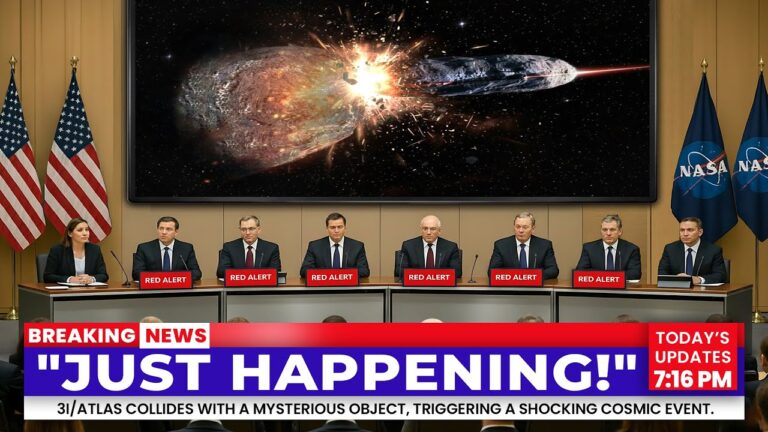
Astrophysicist Avi Loeb delivers a chilling warning: if the enigmatic interstellar object dubbed 3I/ATLAS were on a collision course with Earth, humanity would face an extinction-level event—and it would already be too late to save ourselves.

3I/ATLAS, a massive celestial visitor roughly the size of Manhattan, remains cloaked in uncertainty. We lack detailed imagery, radar maps, or a precise understanding of its trajectory. When it passed its closest point to our Sun on October 29, it was hidden behind the solar glare, preventing the crucial radar observations needed to analyze its composition and path.
Loeb emphasizes the scale of the threat: unlike the more familiar rocky asteroids lingering in near-Earth orbit, 3I/ATLAS isn’t just big, it’s interstellar—originating from beyond our solar system, appearing without warning or predictable patterns. This makes our preparedness dangerously inadequate.
The grim reality is underscored by Loeb’s blunt assessment: if such a colossal object were truly headed Earth’s way, current technology falls woefully short of any reliable deflection strategy. Our best efforts—like NASA’s DART mission, which nudged a small asteroid—simply wouldn’t suffice against an object this size traveling at unimaginable speeds.

Deflecting or destroying a threat like 3I/ATLAS requires interventions years, if not decades, in advance. A delayed response won’t just fail; it could multiply the disaster by fragmenting the object near Earth, resulting in a deadly shotgun blast of debris raining down on the planet.
Even nuclear options, which some have proposed, remain theoretical and fraught with risk. Other advanced concepts such as laser ablation or “painting” the surface of an asteroid to alter its trajectory are untested, especially on an object hurtling through space at such velocity.
Loeb also reflects on humanity’s collective vulnerability, drawing a stark comparison to the dinosaurs—dominant creatures wiped out because they never saw their fate coming. In contrast, we have telescopes and detection programs designed to spot objects threatening Earth.

Yet, despite NASA’s ongoing efforts since 2005 to identify near-Earth objects of a dangerous size, our surveillance focuses mainly on known solar system bodies larger than a football field. Interstellar objects like 3I/ATLAS, arriving from unknown directions, represent an unprecedented blind spot.
The astrophysicist’s message rings urgent and clear: this is a risk from the sky that demands immediate attention and enhanced detection capabilities. Without them, we may be powerless against future interstellar threats crossing our cosmic doorstep without warning.

Loeb’s broader mission extends beyond alerting the scientific community to the urgency of protecting Earth. He champions a new public engagement with science, inspiring a visceral curiosity about space exploration and the unknown.
His impact resonates worldwide—sparking dreams of telescopes for children and igniting passion for science through stories of alien life and cosmic discovery. Yet the ultimate takeaway remains stark: without humility and preparation, our grasp on survival against cosmic threats weakens dangerously.
3I/ATLAS is more than an astronomical curiosity; it is a harbinger of the existential perils lurking in space. For humanity, the question isn’t just can we detect it, but can we act—fast enough, boldly enough—to ensure our place in the universe endures.
The clock is ticking. The unknown object speeds closer. And with it comes a profound test of our technological ingenuity and collective will to survive a cosmic catastrophe long predicted—but never confronted—until now.