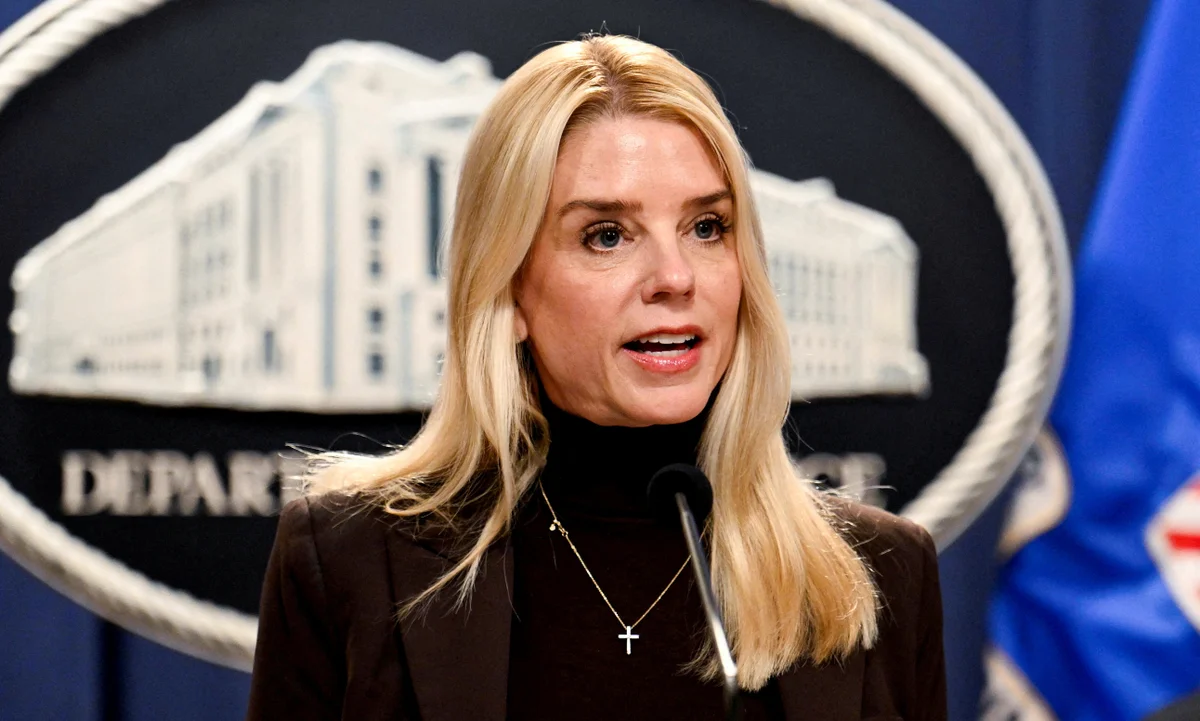
In an explosive turn of events that could reshape the boundaries of executive power, former Attorney General Pam Bondi finds herself under the harsh spotlight—not as defender, but as defendant—after a massive lawsuit was abruptly thrust into the public eye. The suit, filed by former immigration judge Tanya Nimer, alleges that Bondi played a central role in an unlawful firing grounded in discrimination by gender, national origin, and political beliefs.
Nimer’s case pierces the heart of a highly contentious legal battlefield: can the president wield unchecked authority to dismiss federal employees, immune from civil rights laws? This question, once theoretical, now faces a real-world test with extraordinary stakes for the justice system and democracy itself.
The saga begins with Judge Tanya Nimer, a career immigration judge with dual American-Lebanese citizenship, who was appointed in December 2023 but summarily fired after only two weeks on the job. According to the lawsuit, her swift removal was no accident but a deliberate act triggered by her ethnic background and perceived left-leaning political stance.
Under normal circumstances, dismissing a judge requires substantial cause—a threshold seemingly ignored here. Instead, the Trump administration, with Bondi’s approval, executed her termination with shocking expediency, raising immediate questions about the rule of law and discrimination protections within the federal workforce.
The government’s defense rests on a startling claim: the president’s constitutional authority to remove federal judges supersedes civil rights safeguards, including those guaranteed under Title VII. This assertion, if upheld, would grant the executive branch near-absolute power to terminate judges based purely on political or personal biases without legal recourse.
Pam Bondi is slated to defend this controversial stance in court, positioning herself as the architect of a legal argument that could allow politically motivated firings with impunity. Bondi’s role shifts sharply from overseeing legal defenses of governmental actions to personally confronting accusations of enabling discrimination and undermining the judiciary’s independence.
Prior to the lawsuit, Nimer followed protocol by filing a complaint with the Federal Equal Employment Opportunity Commission (EEOC), seeking protection from discriminatory dismissal. Yet, the EEOC dismissed her claim, taking the government’s side by ruling that Title VII does not extend to immigration judges due to the president’s removal powers. This decision effectively erased civil rights safeguards from applicability in this critical context.
Legal experts warn that the case’s implications stretch far beyond a single judge’s dismissal. Should the courts accept the government’s argument, the president could wield unrestrained power to purge federal judges whose views diverge politically, effectively turning the judiciary into an extension of presidential will.
The timing couldn’t be more alarming. The judiciary faces a mounting backlog of 3.6 million cases, with immigration courts overwhelmed and staff depleted. The removal of judges amid this crisis jeopardizes the equitable administration of justice and strains an already overburdened system.
Senator Bernie Marino’s public commentary underscores the systemic issues: instead of firing judges, he advocates for streamlining asylum processing to alleviate the enormity of cases—a stark contrast to the administration’s approach that appears punitive and politically motivated.
Bondi’s legal reasoning draws from a complex fabric of conservative judicial philosophy and executive power expansions championed by Supreme Court justices appointed during the Trump era, including Clarence Thomas’s historical ties. This network of influence fuels concerns that the lawsuit is less about justice and more about cementing unchecked presidential supremacy.
At its core, this lawsuit is not merely a personnel dispute—it is a profound constitutional battleground. It confronts the balance of power among branches of government, the safeguards of civil rights, and the integrity of federal institutions designed to operate free from political interference.
Pam Bondi, long characterized as a loyal prosecutor who retroactively justifies controversial policies, now faces a moment of reckoning that could redefine her legacy. No longer an enforcer of questionable executive decisions, she is put on the defensive to justify actions that may contravene fundamental civil rights protections.
The outcome remains uncertain, but the stakes are enormous. A ruling in favor of Bondi and the government could erode decades of anti-discrimination legal precedent and embolden an administration eager to reshape the judiciary to its liking—undermining democratic principles and legal fairness.
Conversely, a victory for Nimer would reinforce critical limits on the president’s removal power, affirm the relevance of civil rights protections for federal employees, and stand as a bulwark against politically motivated purges.
This case has ignited debate about the future of federal employment protections and the scope of presidential authority. Observers around the nation now await a legal battle that will not only affect the parties involved but potentially transform how power and rights intersect within the American government.
As proceedings advance, every motion, argument, and ruling will be dissected for signs of how America’s legal system defines executive power and protects the vulnerable from discrimination—a test of democracy itself.
Stay vigilant as this landmark case unfolds. What appears initially as a lawsuit over one firing quickly reveals itself as a pivotal moment in the constitutional history of the United States, challenging the rule of law in an era of unprecedented political polarization.
Pam Bondi’s public image and the future of civil rights protections hang in the balance, marking this lawsuit as a monumental fight over justice, equality, and the limits of power at the highest levels of government.
The coming legal drama promises to be intense and consequential, setting a precedent that could reverberate through the federal judiciary and beyond—making this breaking story critical to anyone invested in the protection of democracy and the rule of law.