A Swedish-led astronomy team has announced the discovery of tens of thousands of unidentified objects orbiting Earth, a finding that challenges our understanding of near-Earth space and suggests a non-human presence may have been here for decades. Dr. Beatriz Villarroel of the Nordic Institute for Theoretical Physics presented explosive new data from a multi-year study of historical photographic plates, indicating a staggering population of unknown, highly reflective objects in Earth’s orbit predating human satellite launches.

The research, conducted under the Vanishing & Appearing Sources during a Century of Observations (VASCO) project, analyzed over 600 photographic sky plates from the 1950s taken by the Mount Palomar Observatory. Using automated and citizen-science methods, the team identified approximately 107,000 transient light points in the northern hemisphere alone. A critical statistical analysis revealed that roughly one-third of these transients vanish when in Earth’s shadow, proving they are not plate defects but real, orbiting objects reflecting sunlight.
“This rules out plate defects for a significant fraction of the sample,” Dr. Villarroel stated in an exclusive interview. “Plate defects have no reason to hide from the Earth’s shadow. We are seeing a deficit of these transients in the shadow, which means they are highly reflective objects in orbit.” The team estimates this translates to tens of thousands to over a hundred thousand individual objects present in the 1950s, a number far exceeding any known human-made debris or satellites from that era.
The objects exhibit anomalous characteristics inconsistent with natural phenomena like asteroids. Their appearance as single-point flashes, rather than streaks, suggests they possess extremely flat, smooth surfaces. “If you have something that is natural, a round object or even an elongated asteroid, you are not going to get these on-and-off flashes; you will get streaks,” Villarroel explained. This morphology eerily echoes historical descriptions of “flying saucers.”
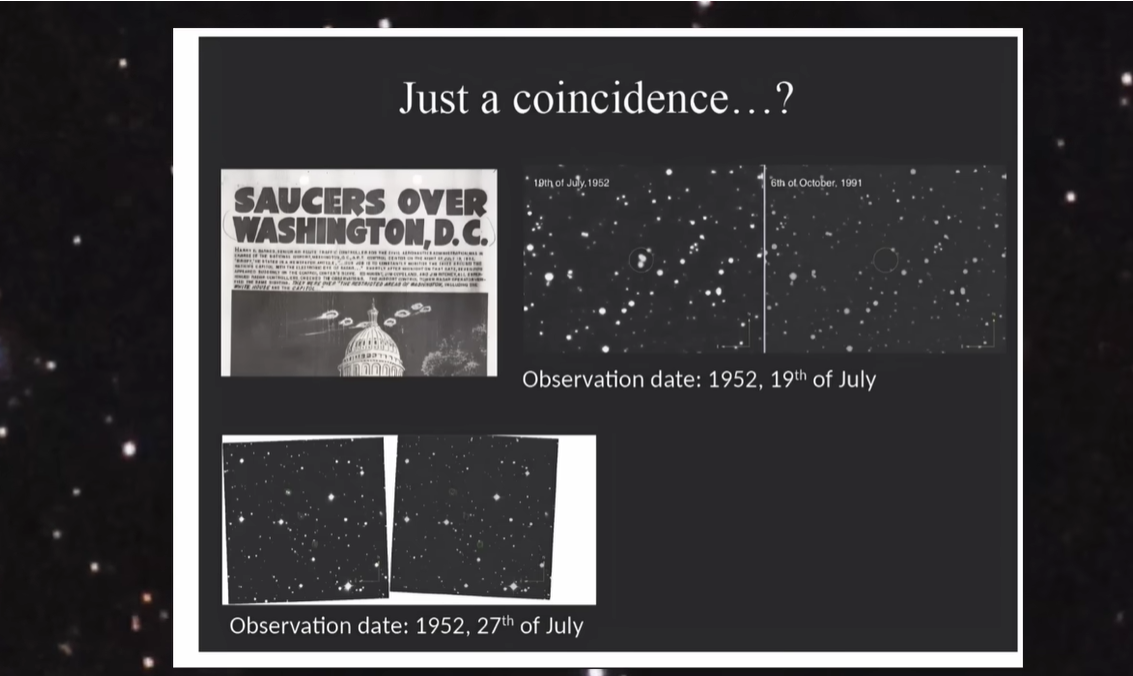
Perhaps more startling are the temporal correlations the team has uncovered. Statistical spikes in transient activity coincide precisely with two major historical events: atmospheric nuclear weapons tests and famous waves of UFO sightings. A 68% increase in transients occurs within a day of a nuclear test. The correlation strengthens on days when both a nuclear test and a UFO wave were reported.

One of the most statistically significant formations involves five transients appearing in a narrow band on July 27, 1952. The probability of such an alignment occurring by chance is 1 in 10,000. This date falls during the infamous Washington D.C. UFO flap, where unknown objects were tracked on radar and observed by pilots. Another candidate formation aligns with the peak of the 1954 global UFO wave.
“We found these alignments before we ever thought about coincidence in time with UFOs,” Villarroel noted. “I had never heard about the Washington flap when we had written that paper already.” This suggests the correlations were discovered objectively, not sought to fit a narrative. The research implies these objects may have been monitoring human activity during pivotal, high-tension moments of the Cold War.
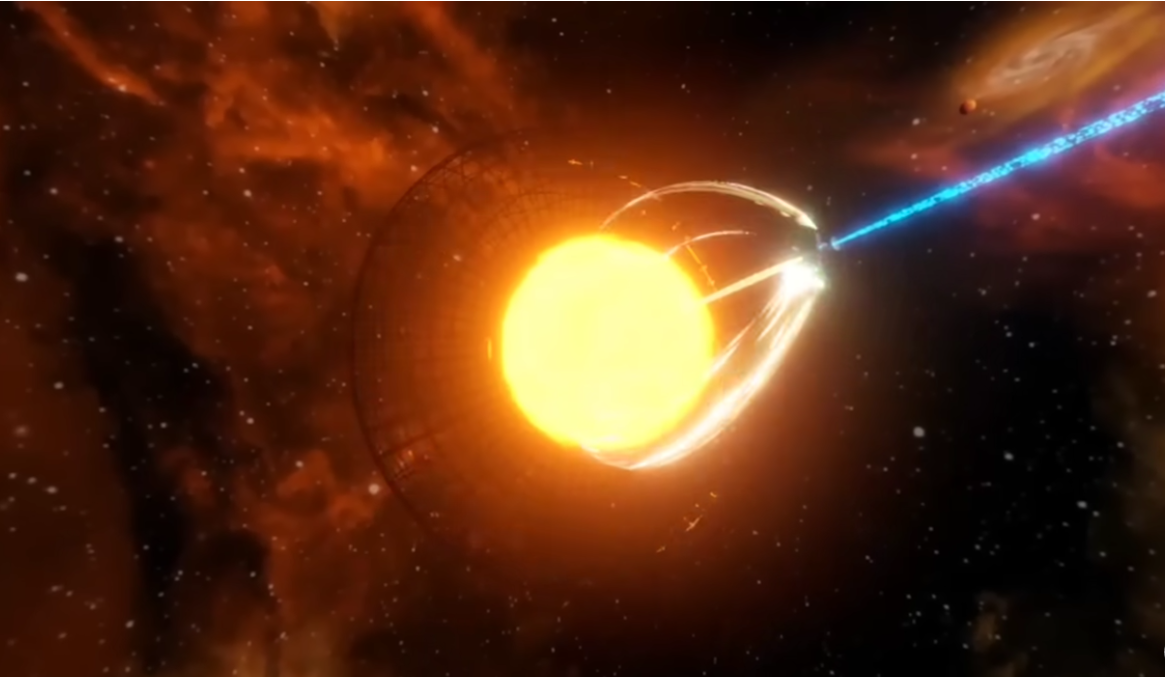
The investigation into these transients began indirectly. Villarroel’s initial research focused on searching for “vanishing stars” as potential signs of distant, super-advanced Kardashev Type III civilizations. The shift to studying near-Earth transients developed over time, challenging her own prior biases against UFO-related phenomena. The VASCO team now includes astronomers, data scientists, and citizen scientists from institutions across Europe and North Africa.
Despite the peer-reviewed publication of their methods and the compelling shadow-test evidence, the astronomical community’s reception has been mixed. Some researchers have attempted to dismiss the findings as plate defects, but their critiques have focused on early, weaker candidate samples and fail to account for the shadow-test results that definitively prove the physical reality of a large subset of the objects.
“Some astronomers still close their eyes and try to say it has to be [defects],” Villarroel said. “But they have no answers for the deficit in the Earth’s shadow.” The team welcomes rigorous scrutiny but emphasizes their conclusions are driven by data from hundreds of plates, not isolated examples.
A pressing modern question arises: are these objects still here? With thousands of human satellites and debris now cluttering orbit, distinguishing potential non-human artifacts has become immensely difficult. Preliminary comparisons suggest the modern rate of transient flashes in the sky is not dramatically higher than in the 1950s, leading Villarroel to a provocative question: “Could it be that many of these flashes people see today and assume are our space trash actually isn’t ours?”
The next phase of research aims to pinpoint the objects’ altitudes using triangulation with modern telescopes and to analyze data from other historical observatories to see if the phenomenon was global or localized. However, Villarroel’s ultimate goal is more direct: a space mission to inspect and potentially retrieve a sample. “Maybe what you will discover is that there are a lot of micrometeorite holes indicative of objects being there more than 20 years… maybe some have been there for at least 500 years,” she speculated.
Such a mission could determine the objects’ age and origin. Villarroel remains scientifically cautious about the origin, stating, “I cannot claim any origin. It could be anything… One can’t exclude a past human civilization we have forgotten about. I have no idea, but it would be nice to get data that tells us how old these objects actually are.”
The VASCO findings represent a paradigm-shifting dataset. The evidence points to a vast, unidentified population of artificial objects in Earth orbit that predate the Space Age, exhibit intelligent formation flying, and appear strategically interested in humanity’s nuclear and aerial activities. While the definitive origin remains unknown, the research demands a serious, scientific investigation into what—or who—has been sharing our orbital space for far longer than previously imagined.