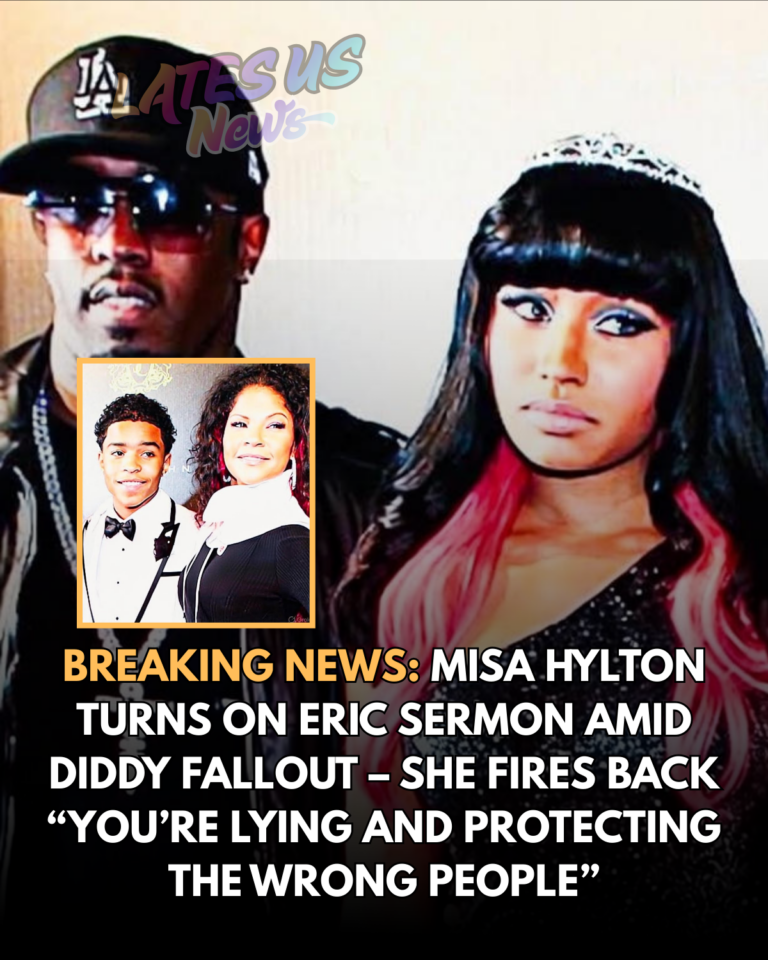
A new and bizarre chapter unfolds in the ongoing saga surrounding Sean “Diddy” Combs, as a public war of words erupts between his ex-girlfriend, stylist Misa Hylton, and legendary producer Eric Sermon. The clash, stemming from testimonies in a recent documentary, has shifted focus from serious allegations to personal grievances, leaving observers questioning motives and credibility.
 The controversy ignited from Sermon’s calm, detailed account in the documentary “The Greatest Love Story Never Told,” where he described Diddy confronting him in the 1990s over Sermon’s then-girlfriend, Misa Hylton. Sermon stated Diddy swung at him, leading to a brief de-escalation before the two men drove off together, leaving Hylton behind. His testimony was presented as an example of Diddy’s alleged pattern of pursuing rivals’ partners.
Misa Hylton has now fiercely responded, issuing a statement read on air that condemns Sermon and the documentary’s impact. “I do not have anything to say except I didn’t deserve any of this, and this documentary has caused a negative impact on my life,” the statement began. It emphasized her relationship with Diddy ended decades ago and she does not speak on him.
Hylton directly attacked Sermon’s credibility, calling his narrative “not only a lie but delusional.” She asserted Diddy knew her independently from Sermon, as both are from Mount Vernon. The statement concluded with what many interpreted as a threat: “Tell him to keep my name out of his mouth before he opens up a can of worms.”
This response has sparked significant backlash from commentators and the public alike. Critics accuse Hylton of inserting herself into a conversation about alleged systemic abuse and power dynamics to center her own victimhood. The documentary details severe accusations against Diddy, including sexual misconduct and violence, making Hylton’s focus on a decades-old personal slight appear wildly misplaced.
The situation grew stranger as Eric Sermon appeared on The Breakfast Club to unequivocally stand by his story. With relaxed demeanor, he elaborated on the incident, confirming Diddy threw a punch and that he chose not to retaliate out of respect for Hylton’s presence. “I never cap,” Sermon stated, using slang for lying. He clarified they drove around the corner to avoid a scene, eventually calming down.
 Sermon’s account directly contradicts Hylton’s implied timeline and characterization of events. His straightforward testimony, devoid of theatrics, has garnered public support, while Hylton’s cryptic warning and perceived deflection have drawn scrutiny. The core question now dominating discussion is why Hylton is launching such a vehement defense.
Observers note Hylton’s statement bizarrely frames Sermon speaking on his own life experience as a personal attack. In the context of a documentary alleging grave crimes, her accusation that it’s “sad” a legend is “speaking on another man’s life” has been interpreted as echoing a damaging “no snitching” culture, potentially silencing other voices.
The irony is heightened by commentary from figures like 50 Cent, who highlighted Diddy’s alleged pattern of pursuing women linked to his rivals, such as Tupac Shakur. This context frames Sermon’s story not as gossip, but as potential evidence of a behavioral pattern, making Hylton’s outrage seem even more disconnected from the larger narrative.
Legal analysts suggest Hylton’s “can of worms” warning could be counterproductive. In an environment with federal investigations, such vague threats can be seen as attempts to intimidate witnesses. If Hylton possesses knowledge of illegal activity, her duty would be to report it to authorities, not issue veiled warnings on social media.
The public reaction has been overwhelmingly in Sermon’s favor, with many praising his dignified response. Meanwhile, Hylton faces accusations of performing loyalty to Diddy at the expense of her own legacy as a celebrated stylist. The debate has unfortunately diverted oxygen from the serious allegations at the heart of the documentary.

This personal feud underscores a larger tension in the coverage of the Diddy scandal: the struggle between confronting hard truths and the distractions of celebrity drama. As survivors come forward with traumatic accounts, narratives like Hylton’s risk reducing a complex story of power to a petty love triangle.
Experts in media manipulation point to Hylton’s actions as a potential deflection tactic, whether intentional or not. By creating a sensational, interpersonal side-conflict, the core issues of alleged abuse and accountability can become muddied in the court of public opinion.
Sermon’s refusal to engage in hostility, simply reiterating his truth, stands in stark contrast. His narrative remains consistent and grounded, while Hylton’s position appears reactive and emotionally charged. This dichotomy is shaping public perception significantly.
The fallout is immediate for Hylton’s reputation. Once revered as an architect of hip-hop fashion, she is now facing a wave of criticism for her statements. The conversation has swiftly turned from her creative contributions to analyzing her current allegiances and motivations.
 For Diddy, who faces multiple lawsuits and a federal investigation, this distraction may be temporarily beneficial. However, the renewed discussion of his past behavior, including the pursuit of associates’ partners, only adds another layer to the public portrait being assembled by prosecutors and the press.
As the story develops, all eyes are on whether other figures will come forward to corroborate either side. The “can of worms” Hylton referenced remains ominously unopened, leaving room for further revelations. The pressure on all parties involved is intensifying by the hour.
The ultimate tragedy, as voiced by many commentators, is that this personal spat is overshadowing the voices of those who allege profound suffering. The urgent calls for justice and systemic change risk being drowned out by a noisy, confusing, and ultimately secondary conflict.
This incident serves as a case study in how narratives around powerful figures can fracture. It reveals the difficult path for those seeking truth when faced with interpersonal loyalties, personal grievances, and the chaotic amplification of social media.
Eric Sermon has exited the fray, having said his piece. Misa Hylton remains at the center of a storm largely of her own making. The court of public opinion continues to deliberate, but the real stakes lie far beyond this odd and escalating war of words. The truth, as they say, needs no choreography.